
Maybe you want to build something useful without making your face, name, and private life part of the product. That’s possible with many home businesses—but anonymous usually means keeping a low public profile, not being unknown to everyone involved.
Niche websites, digital products, print-on-demand, writing, and other behind-the-scenes services can all be run without turning yourself into a public personality.
Still, banks, payment providers, marketplaces, tax authorities, and sometimes clients may need your real details. The right choice depends on how visible you’re comfortable being, how much customer contact you want, and what skills you can offer.
Before choosing an idea, decide what “anonymous” means to you
People use anonymous, faceless, and private as if they mean the same thing. They don’t quite.
| Term | What it usually means | What it doesn’t guarantee |
|---|---|---|
| Faceless | You don’t show your face in your content or marketing. | That customers or platforms won’t ask who you are. |
| Pseudonymous | You publish or sell under a pen name, brand name, or business name. | That your identity is hidden from banks, payment providers, or authorities. |
| Low-profile | You limit how much personal information you share publicly. | That you can avoid ordinary business, tax, or consumer rules. |
| Anonymous | Your identity isn’t obvious to the general public. | Complete anonymity across every service and transaction. |
A more practical goal is public privacy with legitimate business operations. A writer, for example, might publish under a studio name while giving a client their real details for a contract and invoice. A digital-product seller might use a brand in public and their legal information with a payment provider.
Rules vary by location, business structure, and platform. Before you start, check the requirements that apply where you live and where you plan to sell.
12 home business opportunities that don’t require a public persona
These ideas can keep you out of the spotlight. None guarantees that you’ll be anonymous to everyone, and each has its own tradeoffs around customer contact, platform rules, and setup.
1. Build a niche affiliate website
A niche website answers questions for a particular audience—perhaps people learning to garden, organize a small home, or travel on a budget. You can publish under a brand name and earn commissions when readers buy products through disclosed affiliate links.
This suits someone who enjoys researching and writing more than live selling. It can take time to build useful content and attract visitors. Affiliate programs may also ask for your legal and payment details, and you should disclose commercial relationships wherever required.
Privacy reality: Little public exposure is needed, but affiliate programs and payment services may need to identify you.
2. Publish a paid newsletter or resource site
A newsletter can share practical advice on a focused topic under a publication name. Depending on the audience and business model, revenue might come from subscriptions, sponsorships, or related products.
The work is steady: readers expect useful updates, and some will ask questions. You can keep your face out of the brand, but newsletter and payment platforms may request identity information. Rules for commercial messages also vary by location.
Privacy reality: Readers can interact with the publication without knowing your personal story, while service providers may verify the publisher.
3. Sell digital guides, worksheets, or checklists
Digital downloads can include planners, trackers, short guides, worksheets, and reference materials. You create a file and sell access through a marketplace or your own website.
The appeal is the quiet focus: make something helpful, describe it clearly, and let the product do the talking. You’ll still need to answer buyer questions and check the seller-information and refund rules of your chosen platform.
Privacy reality: A brand can be front and center; platform requirements determine what customers see about the seller.
4. Create templates and printable products
Templates for budgeting, project planning, business workflows, or design tasks can be sold as downloadable files. Printables might include calendars, labels, activity sheets, or simple reference pages.
This can suit someone who likes turning messy information into something clear and usable. The hard part is finding a specific need. A template for a particular group is more useful than another generic planner lost in a crowded marketplace.
Privacy reality: The product can carry the brand, though customers may still contact you for support.
5. Open a print-on-demand shop
With print-on-demand, items such as shirts, posters, or mugs are produced after a customer orders. You create or license the designs; a provider handles much of the printing and shipping.
You don’t need to appear in the marketing. You do need a clear niche, original designs, accurate descriptions, and a plan for customer questions or returns. Read the provider’s rules on seller details, intellectual property, and support before opening a shop.
Privacy reality: A shop can use a business name, but you remain responsible for the business.
6. License stock illustrations, photos, or audio
If you create visual or audio assets, you may be able to license them through stock libraries or a branded portfolio. Buyers are often searching for the right asset, not the person behind it.
Building a useful catalog takes time, and sales can be unpredictable. Before uploading, understand the licensing terms so you know how buyers may use your work.
Privacy reality: A studio name may be enough for the public-facing side, subject to each platform’s account rules.
7. Offer ghostwriting or copywriting
Ghostwriters create articles, website copy, emails, or other material that a client publishes under their own name or brand. The work happens behind the scenes, which can suit someone who likes writing but not public attention.
You will usually need direct client communication, clear project terms, and a way to show writing samples. You can use a portfolio brand and publish selected samples with the client’s permission.
Privacy reality: You may stay out of public view, though clients will often know who they hired.
8. Provide proofreading or editing
Editors and proofreaders help writers, businesses, or publishers improve clarity, grammar, structure, and consistency. You can promote the service under a business name and communicate by email or project tools.
Be specific about what you edit—blog posts, product descriptions, reports—and what your service doesn’t include. Clear boundaries help both you and the client understand what the finished work will look like.
Privacy reality: You don’t need a public persona, but some clients may request contracts, invoices, or meetings.
9. Build or maintain websites
A website service might focus on setting up basic pages, fixing common content-management issues, updating plugins, or maintaining small-business websites. Much of the work can happen remotely and behind the scenes.
Clients will care about examples, reliability, and clear boundaries. Explain what access you need, how you’ll handle credentials, and what happens if something goes wrong. Be honest about your experience and technical skills.
Privacy reality: Your name can stay out of the marketing, but a client relationship is part of the work.
10. Offer SEO research or content support
SEO support can include keyword research, content briefs, page reviews, internal-link suggestions, or content calendars. If you like analysis and written communication, you may be able to deliver this service without becoming a public-facing personality.
Describe the work in concrete terms. Avoid promising rankings, traffic, or sales; search outcomes depend on many factors beyond one person’s control.
Privacy reality: Public visibility can be low, though clients may want to know who is working on their site and data.
11. Provide online research or data organization
Some businesses need help collecting public information, organizing spreadsheets, checking sources, or preparing research summaries. You can offer this as a behind-the-scenes service with written communication.
Be clear about your method and sources. Take care with sensitive personal information; don’t handle it unless you understand the client’s privacy and security requirements and can meet them.
Privacy reality: You can avoid public promotion, but trust, confidentiality, and accuracy matter.
12. Create a small software tool or no-code automation
A simple calculator, workflow template, browser tool, or automation can solve a narrow problem for a specific audience. You can brand the product without making yourself its public face.
This route calls for technical skills—or a willingness to learn—as well as maintenance and customer support. Start with a small problem people already describe. It’s easier to improve a modest tool that someone needs than to build a big product and hope a market appears.
Privacy reality: You don’t need to be the face of the product, but customers still need support and clear product information.
How to choose an idea that fits your privacy needs
Start with the work itself, not the promise of anonymity. An idea that looks private on paper may involve constant calls, public promotion, or more customer support than you want.
Rate each option from 1 to 5 on these four questions:
- Public visibility: How much personal information would appear on a website, profile, portfolio, or social account?
- Customer contact: How many conversations, calls, or support requests might the work involve?
- Skill fit: Can you deliver the work now, or are you willing to learn the necessary skills?
- Startup burden: What tools, training, inventory, subscriptions, or fees would you need?
Then write down your non-negotiables. Perhaps you don’t want to appear on camera. Maybe email is fine, but regular calls aren’t. You might be comfortable using a brand name while letting clients know who they’re hiring.
Choose one idea that meets your essential requirements and test it on a small scale. Starting several unrelated businesses at once can make it harder to see what customers actually want.
For more ideas, see 18 home business ideas without showing your face.
How to protect your privacy without hiding your business
Use a separate public-facing identity
A business name, publication name, or permitted pen name can keep your personal identity out of marketing. Use it consistently across your website, email address, and business profiles.
Keep the information you give to banks, payment providers, tax agencies, and other services accurate. A public brand name isn’t a substitute for legal identity verification.
Check domain and platform privacy settings
Some domain providers offer privacy or proxy services that limit the personal contact information displayed in public domain registration records. Availability and details vary. ICANN explains how these services can publish alternative contact information, while the provider’s identity and service terms remain relevant.
Read the terms for your domain ending, registrar, marketplace, and payment provider. One privacy setting won’t necessarily cover every service you use.
Keep business contact details separate
Where permitted, use a business email address and a separate phone or contact channel. If you’re considering a mailbox or business-address service, check that it’s allowed for your business, payment provider, and local registration requirements.
Think carefully before publishing your home address. At the same time, never use a false address or provide false information where accurate details are required.
Secure your accounts and devices
Use strong, unique passwords and two-factor authentication. Limit access to business accounts, keep personal and business files separate, and remove location or identifying details from images when appropriate. Privacy depends on ordinary security habits as much as it does on what appears on your website.
Keep accurate records
Payment providers may verify a business and the people responsible for its account. For example, Stripe’s verification guidance describes checking business details and information about account representatives or owners; exact requirements depend on the provider and country.
Keep records of sales, fees, expenses, and customer transactions. Business registration and tax rules differ by location, so check your official local guidance or speak with a qualified adviser if you’re unsure.
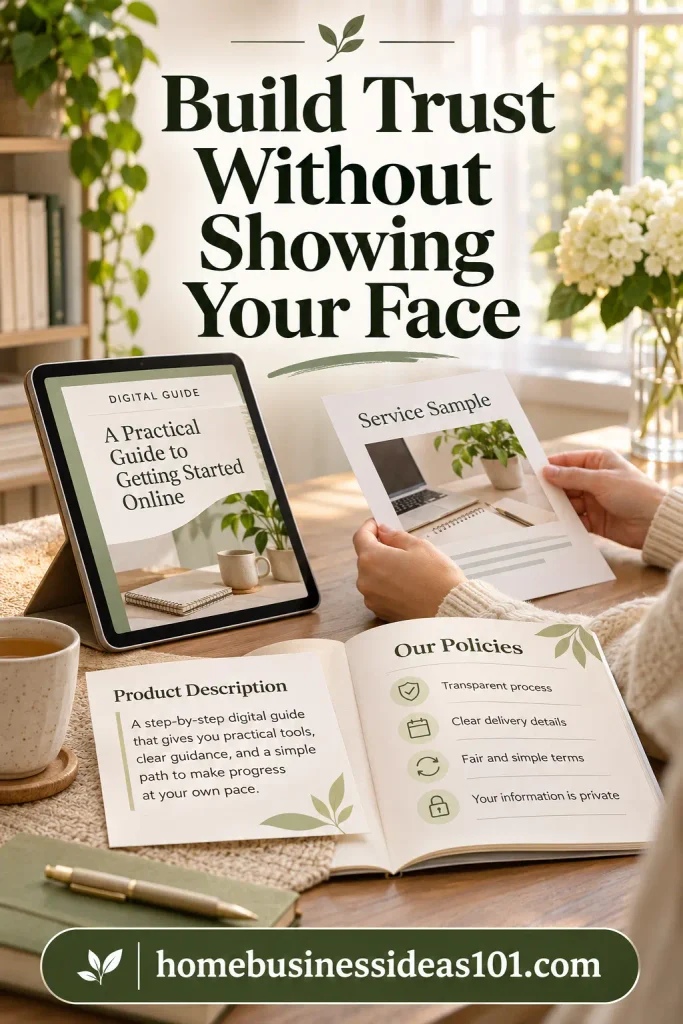
How to earn trust without showing your face
Customers don’t need your life story to decide whether an offer is credible. They need to understand what they’re buying and what to expect.
Make your website or profile clear about:
- What the product or service includes
- Who it’s designed for
- What it costs and how delivery works
- How customers can contact you
- What support, refund, or privacy policies apply
- What qualifications or experience you actually have
Use genuine samples when possible. If you’re new, say so and show the work you can do. Don’t invent testimonials, imply that you tested something you haven’t tested, or promise an outcome you can’t control.
Before paying for a work-from-home opportunity, pause
A private or faceless business should still have a clear business model. Be cautious when an offer leans on guaranteed income, little work, secret methods, or expensive starter packages but gives few details about what customers will actually buy.
Before paying for a course, system, or opportunity:
- Find out exactly what the product or service is.
- Check the total cost, recurring fees, and refund terms.
- Search for the company name alongside words such as “complaint” or “scam.”
- Look for independent information, not only testimonials on the seller’s page.
- Take time to compare the offer with lower-cost ways to learn the same skill.
The U.S. Federal Trade Commission warns about work-from-home offers promising high earnings for little time or effort and advises consumers to research the company. If you live elsewhere, check your local consumer-protection authority for guidance.
For a more detailed checklist, see Before You Pay for a Home Business Opportunity: 8 Checks.
A 30-day plan to test a low-profile business
Days 1–7: Choose a problem and an audience.
Pick one business idea. Describe who it helps, what problem it solves, and how customers might find it. Look at existing offers and note the questions or gaps you could address.
Days 8–14: Make one small offer.
Create a digital product, service package, sample, or landing page. Use a business name if that suits your privacy needs, and make the offer easy to understand.
Days 15–21: Put it in front of potential customers.
Use a suitable marketplace, website, search-focused article, or community where promotion is allowed. Keep your claims accurate. Pay attention to the questions people ask.
Days 22–30: Review the response.
Track visits, inquiries, sales, costs, and the time involved. If interest is quiet, adjust the offer or audience before investing more. If people respond, find out what they value and improve the next version.
This first month is a way to gather information, not a promise of income. A few simple systems can help keep the work manageable; see 7 Simple Systems That Keep a One-Person Home Business Organized.
Questions people ask before starting a private home business
“Can I do this without showing my face?”
Yes. Many businesses rely on written content, digital products, design assets, websites, or behind-the-scenes services. You may still need to communicate with clients or provide your identity to service providers.
Recommended guide: 14 Home Business Ideas Without Showing Your Face—and How Each One Makes Money
“Can I use a business name instead of my own?”
Often, a business can use a public-facing brand name, but legal requirements vary by country and business structure. Platforms may also require your real information even when customers see a brand.
“Could a customer find out who owns the business?”
Possibly. That depends on your location, business structure, platform, payment method, and the disclosures required for your type of business. Check local rules and the terms of the services you use.
“Do I have to use social media?”
No. A website, marketplace, search traffic, referrals, or direct outreach may suit some business models better. Choose channels based on how your potential customers look for solutions.
Recommended guide: 12 Home Business Ideas Without Social Media: Online Models and How They Get Customers
“Is it legal to run an anonymous business?”
Using a public brand or pseudonym can be legitimate, but it doesn’t remove applicable registration, tax, payment, consumer-protection, or licensing responsibilities. Check the rules that apply where you live and where you sell.
Products / Tools / Resources
The right tools won’t make a business anonymous, but they can help you protect your public privacy and keep the work organized.
- Domain privacy: Before paying for a privacy or proxy service, read ICANN’s overview of domain privacy and proxy services. Availability and terms vary.
- Payment account requirements: If you use Stripe, review its verification guide and check the requirements shown for your country and account.
- Recordkeeping: Use a simple spreadsheet or bookkeeping tool to track income, fees, expenses, and receipts. If you’re in the United States, the IRS recordkeeping guide explains the records businesses may need to support their tax reporting.
- Scam checks: U.S. readers can review the FTC’s advice on avoiding work-from-home scams. Elsewhere, look for guidance from your national consumer-protection authority.