
A new order comes in. The payment notification appears. For a moment, it feels like proof that the business is working.
But a sale is only the start of the calculation. There may be materials to buy, fees to pay, hours of work to do, and bills waiting at the end of the month. That’s why, if you’re wondering how to know if a home business is profitable, the answer starts with more than sales.
Compare what the business earns with what it costs to run. Then look at how much cash remains, how much time you put in, and whether the result meets your goals.
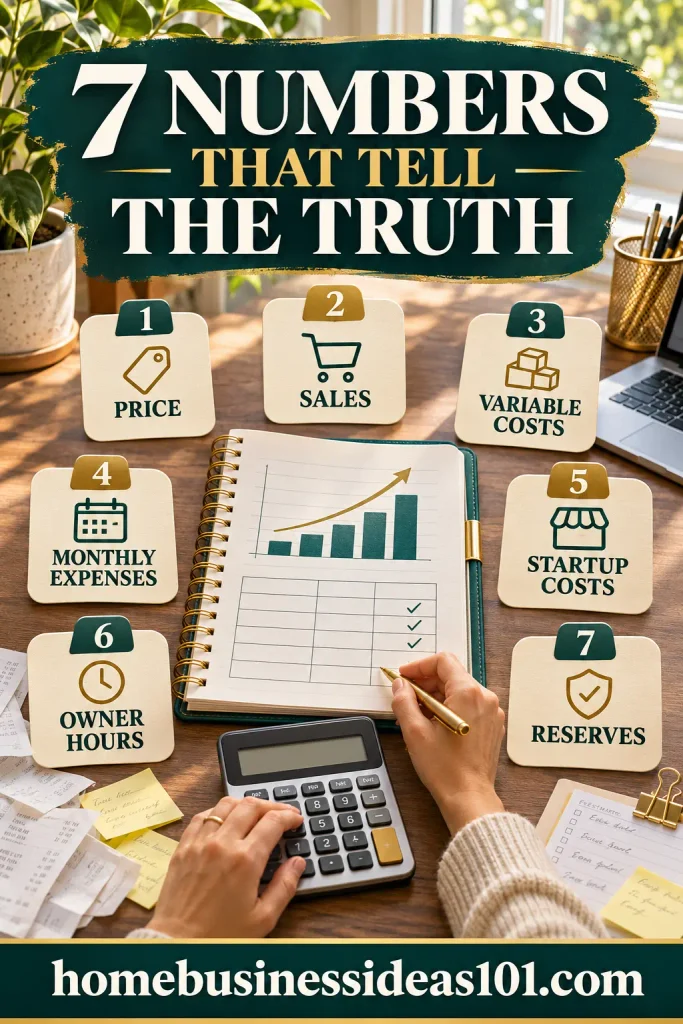
Here are seven numbers that can help you see the picture more clearly.
The seven numbers behind a useful profitability check
Gather these figures for a typical month. If the business hasn’t launched yet, estimate them and mark them clearly as projections. As real sales and costs come in, replace your estimates with actual numbers.
1. What you actually collect for each sale
Start with the average amount a customer pays after discounts and refunds. Your advertised price may be $100, for example, but if you regularly offer a lower price, use the amount you tend to collect.
If you sell several products or services, calculate an average that reflects your expected sales mix. A low-priced item that sells often may affect your real average more than a premium offer that rarely sells.
2. How many paid sales you complete in a month
Count completed, paid orders, clients, or projects—not inquiries, likes, or people who say they’re interested.
For a new business, estimate a realistic number and write down what the estimate assumes. How many potential customers will see your offer? How many might buy? How much work can you deliver without stretching your schedule?
A modest estimate you can explain is more useful than a hopeful number with no clear basis.
3. What each sale costs you to deliver
Variable costs change with the number of sales. Depending on the business, they might include:
- Materials or inventory
- Packaging and shipping
- Payment processing fees
- Sales commissions
- Subcontractor costs tied to fulfilling an order
- Platform fees charged per transaction
These costs are easy to overlook when you’re focused on what a customer pays. But a portion of each sale may already be spoken for before you’ve covered a single monthly bill.
4. What it costs to keep the business running each month
List recurring expenses that stay fairly steady over a given period: software, insurance, a business phone plan, or regular professional services.
Some costs are mixed. A phone plan might have a fixed monthly fee and additional usage charges. Where you can, separate the fixed portion from the part that rises as the business grows. The SBA recommends accounting for fixed, variable, and semi-variable costs when estimating a break-even point.
5. What you spent to get started
Record one-time startup costs separately from monthly expenses. Depending on the business, those might include equipment, licenses, initial inventory, a website, or professional help.
This distinction matters. If you count the full price of a one-time purchase as a monthly cost, you may overstate your regular expenses. If you ignore it altogether, you may underestimate how long it will take to recover what you put in.
For a practical payback estimate, compare startup spending with the money the business can retain after ongoing expenses and planned reserves. Accounting and tax treatment can vary by expense and location.
6. How many hours you work
Count the visible work and the work that tends to fill the gaps: finding customers, answering emails, preparing orders, updating a website, handling returns, and keeping records.
Your time may not appear as a wage expense in your business accounts; the treatment depends on your business structure and accounting rules. Still, it matters when you’re deciding whether the business is worthwhile. You can calculate the profit available per owner-hour as a separate measure.
7. What you need to set aside for taxes and irregular bills
Plan for tax obligations and costs that don’t arrive every month, such as annual renewals, equipment replacement, repairs, or refunds. The right tax estimate depends on where you live, your business structure, and your circumstances. Check local guidance or speak with a qualified tax professional.
Keep this reserve separate in your thinking from operating profit. It’s a cash-planning estimate, not automatically a business expense or a tax calculation.
Put the numbers into a simple monthly calculation
With the first four figures, you can estimate monthly operating profit:
Monthly sales = average amount collected per sale × completed sales
Total variable costs = variable cost per sale × completed sales
Operating profit before income taxes = monthly sales − total variable costs − recurring fixed costs
This is a simplified planning calculation, not a substitute for formal accounts. Keep your assumptions visible and update them when you have actual results.
A worked example
Imagine a home business that collects an average of $80 per sale, completes 60 sales in a month, and spends $25 to deliver each sale. Its recurring monthly expenses are $1,600.
| Measure | Calculation | Amount |
|---|---|---|
| Monthly sales | $80 × 60 | $4,800 |
| Variable costs | $25 × 60 | $1,500 |
| Money left after variable costs | $4,800 − $1,500 | $3,300 |
| Operating profit before income taxes | $3,300 − $1,600 | $1,700 |
The business has an estimated $1,700 in monthly operating profit before income taxes. That’s more revealing than the $4,800 in sales—but it still leaves two important questions. How many sales are needed just to break even? And does the result justify the owner’s time?
Find the number of sales needed to break even
The break-even point is where sales revenue covers costs, leaving no profit or loss. For a single product or service, use this formula:
Break-even sales in units = monthly fixed costs ÷ (price per sale − variable cost per sale)
With the example figures:
$1,600 ÷ ($80 − $25) = 29.1 sales
So the business would need about 30 sales in a month to cover the fixed costs in this simplified example. The SBA uses the same basic break-even formula and notes that the estimate depends on the prices, costs, and sales assumptions you enter.
If you sell different products or services at different prices, calculate the break-even point for each or use an average that reflects your sales mix. One simple average can hide a lot if a high-cost service makes up a large share of your work.
Break-even is a planning tool, not a promise that you’ll make a certain number of sales. Ask whether the target fits your likely customer demand, marketing, schedule, and capacity to deliver.
Ask what the profit means for your time
In the example, suppose the owner spends 85 hours working in the business that month. The $1,700 operating profit divided by 85 hours comes to $20 per owner-hour before income taxes and reserves.
That number isn’t necessarily a wage, and it doesn’t mean the owner should withdraw all $1,700. It’s a way to compare the business’s financial result with the time it asks from you.
Say your goal is to earn the equivalent of $25 per hour for those 85 hours. That would require $2,125 before taxes and reserves. The example falls short by $425.
That gap doesn’t decide the future of the business for you. It gives you something specific to investigate. Could you raise your price? Reduce the time needed to deliver each order? Bring in more sales without adding the same amount of work?
Keep profit, cash flow, and withdrawals in their own lanes
Profit and cash flow describe different things. Profit estimates whether sales exceed expenses over a period. Cash flow tracks when money comes in and when bills have to be paid.
A business may show a profit on paper while waiting for customers to pay invoices. It may also have money in the account from a loan or an owner contribution, even when sales haven’t covered its expenses.
Withdrawals need context too. In many business structures, taking money out of the business isn’t recorded the same way as paying a business expense. The treatment depends on the structure and the relevant accounting rules.
Good records help you follow the money. The IRS says business records can help owners monitor progress, prepare financial statements, identify income and expenses, and support tax reporting.
Be careful with costs you share between home and business
Running a business from home doesn’t automatically make your household expenses business expenses. For your own planning, identify costs created by the business and estimate any shared costs that genuinely relate to it.
Tax deductions have their own rules. In the United States, for instance, home-office deductions have eligibility requirements, and the IRS provides different methods for calculating them. Other countries may apply different rules.
Keep your receipts and records, and check the rules where you file taxes. Don’t count the full cost of a household bill as a business cost simply because you sometimes work at home.
Look for a pattern, not a perfect month
A busy month can feel reassuring. A slow month can feel like a warning. Neither one necessarily tells the whole story.
Review several periods that reflect the way the business operates. If sales are seasonal, compare similar seasons where possible. Then ask:
- Does operating profit stay positive after ordinary business expenses?
- Is the break-even target realistic?
- Does the result per owner-hour come close to your goal?
- Is cash available for upcoming bills and planned reserves?
- Do sales rely heavily on one customer, product, or marketing source?
- Are higher sales also bringing higher expenses or more unpaid work?
There’s no single profit margin that makes every home business healthy. An online shop, a consulting service, and a tutoring business can have very different prices, costs, and time demands. What matters is whether the model covers its costs and fits your financial and personal goals.
If the numbers disappoint you, choose one thing to test
A calculation is most useful when it points to a next step. Try to identify the part of the business that is putting pressure on the result.
- Each sale leaves too little behind: Review your price, delivery costs, and transaction fees.
- Monthly expenses are heavy: Look for recurring costs that aren’t helping you serve customers or make sales.
- Break-even requires more sales than seem realistic: Test demand on a smaller scale or revise the offer before committing more money.
- Profit per hour is low: Consider whether you can simplify delivery, narrow the service, or reduce repeated tasks.
- Profit looks fine but cash is tight: Review when customers pay, when bills are due, and what you need to reserve.
If you haven’t launched yet, treat your forecast as a hypothesis. Try the smallest practical version of your offer, record what it actually costs, and update the calculation when real sales come in.
Questions that come up when you check profitability
“How do I know whether my home business is actually profitable?”
Compare sales with variable costs and recurring business expenses for a consistent period. Then look at cash flow, startup-cost recovery, and profit per owner-hour to see whether the result meets your goals.
“Is revenue just another word for profit?”
No. Revenue is the money earned from sales before expenses. Profit is what remains after applicable expenses are subtracted.
“Can I make sales and still lose money?”
Yes. If the costs of fulfilling those sales and running the business add up to more than the sales revenue, the business can lose money while making sales.
“How much profit should my home business make?”
There isn’t one amount that fits every business. Your useful target depends on your costs, hours, financial needs, and business model. Start by calculating break-even and deciding what return you want for your time.
“Can I tell if an idea will be profitable before I start?”
You can estimate its potential, but a forecast can’t prove what customers will buy. Estimate demand, prices, costs, and sales volume, then test the offer on a small scale before making larger commitments.
Products / Tools / Resources
You don’t need complicated software to start. A spreadsheet with monthly columns for sales, costs, hours, and cash reserves is enough to make your assumptions visible and compare them with actual results.
- SBA Break-Even Point Calculator: A free way to estimate the sales volume needed to cover fixed and variable costs. legacy.sba.gov
- IRS Recordkeeping Guide: An overview of business records and why they help with financial statements, expense tracking, and tax reporting. www.irs.gov
- IRS Home Office Deduction Guidance: U.S.-specific information on eligibility and methods for calculating a home-office deduction. www.irs.gov